
Wherever structural steel passes through the building envelope, it carries heat straight past the insulation. A steel-to-steel thermal break stops that heat flow by placing a high-strength, low-conductivity plate between the interior and exterior steel, so the connection still carries its loads but no longer acts as a thermal bridge.
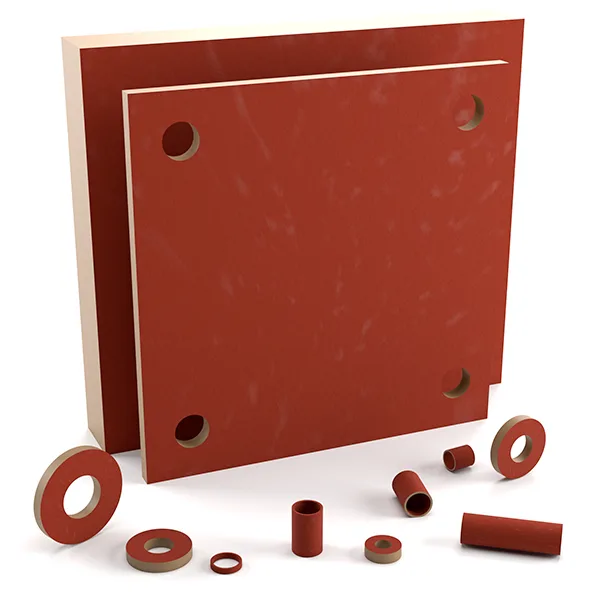
STB-1 is a thermoset, reinforced composite made for exactly this job: 48,000 psi in compression, rated ASTM E84 Class A, and cut, drilled and machined to your connection drawings in Canada. Matching thermal break washers and Thermal Bushings complete the break at every bolt.
Where Steel Thermal Breaks Are Used
- Cantilevered beams at steel balconies and canopies: bolted end-plate moment connections
- Rooftop dunnage and posts supporting HVAC units, screens and solar frames: base plates on steel framing
- Shelf angles and relieving angles on steel spandrel beams: pads and shims behind the angle
- Parapet outriggers and roof-to-wall steel crossing the air and insulation line
- Curtain wall and cladding brackets bolted to the steel frame
- Exterior columns bearing on interior steel or foundations
Common Steel-to-Steel Connection Types
| Connection | How the thermal break is installed | Main checks |
|---|---|---|
| Bolted end-plate moment connection | STB-1 pad between two welded end plates, bolts isolated with washers and bushings | Bolt tension, shear and bending; pad bearing; end-plate prying |
| Shear tab or fin plate | STB-1 pad between the tab and the supporting plate or a short stub | Bolt shear and bending through the added grip |
| Base plate on steel framing | STB-1 pad under the full base plate, anchors or bolts isolated | Bearing, uplift, bolt bending |
| Angle or bracket to steel beam | STB-1 shims at each bolt, or a continuous strip | Eccentric shear, bolt bending, adjustment slots |
Why STB-1 for Structural Steel
| Property | STB-1 |
|---|---|
| Compressive strength (ASTM D695) | 48,000 psi (330.9 MPa) |
| Shear strength (ASTM D732) | 16,326 psi (112.56 MPa) |
| Compressive modulus, 1″ thick | 830,000 psi |
| Thermal conductivity (ASTM C177) | 1.055 BTU·in/hr·ft²·°F |
| Fire | ASTM E84 Class A; Euroclass B |
| Operating temperature | -60 °F to +220 °F |
| Standard thicknesses | 1/4″, 1/2″, 3/4″, 1″, 2″ |
| Typical lead time | 5–7 days, cut and drilled |
STB-1 conducts heat more than 350 times less than steel, more than 100 times less than stainless steel and more than 1,300 times less than aluminum. Expected long-term deflection is 1.25 × the initial elastic deflection at bearing stresses up to 2,000 psi, with creep and permanent set limited to 5% of the original thickness.
Comparing products? See STB-1 vs Armatherm FRR and thermal break pads vs modules.
Designing a Thermally Broken Steel Connection
- Split the member at the insulation line and add end plates or a base plate on each side.
- Size the STB-1 pad to the plate and set the thickness: 1/2″ to 1″ for most connections.
- Check the bolts for combined shear, tension and bending through the longer grip.
- Isolate every bolt with thermal break washers and Thermal Bushings.
- Detail the envelope: seal the air and vapour barrier around the connection and flash water away.
Full checklist and a worked example: Structural Steel Thermal Break Design Guide. Spec language: guide specification 07 21 00.
Final connection design is the responsibility of the project’s structural engineer of record.
Steel Thermal Break FAQ
What is a steel-to-steel thermal break?
A steel-to-steel thermal break is a load-bearing, low-conductivity plate installed between two steel members where they cross the building envelope, such as between end plates of a canopy beam. It carries compression and shear while blocking the conductive heat path through the steel.
What material is used for steel thermal breaks?
High-strength thermoset composite plates such as STB-1 are used for structural steel connections. STB-1 has a compressive strength of 48,000 psi and a thermal conductivity of 1.055 BTU·in/hr·ft²·°F, more than 350 times lower than steel.
How do you stop heat travelling through the bolts?
Install thermal break washers between the steel washer and the exterior steel, and Thermal Bushings through the holes in the exterior plate, so the bolts never touch the cold steel.
Can a thermally broken steel connection be slip-critical?
A thermal break plate in the grip changes the faying surfaces and can affect clamping over time. Confirm the design approach under the governing steel design standard; most thermally broken connections are designed as snug-tight or pretensioned bearing connections.
How thick should a steel-to-steel thermal break be?
Most steel connections use 1/2″ to 1″ STB-1. Thicker pads reduce heat flow further but lengthen the bolt grip and increase bolt bending, so the engineer of record sets the thickness.
More from Benchmark: STB-1 is manufactured by Benchmark in Canada. See STB-1 structural thermal break systems on bmssi.ca and Benchmark’s full structural thermal break range.
Request a Quote or Data Sheet
Send us your connection drawings, bolt schedule or load requirements and we will quote STB-1, TBF, washers and bushings cut and machined to your specification. Data sheets and design support are available for engineers and architects.
Call 800-580-4195 or use the form below. STB-1 typically ships in 5–7 days; TBF in as little as 3 days.